
We have focused on the electric vehicle transition in India now for the past 8 years. In this period, the electric race in scooters, autos and cars has been largely settled with winners emerging across these segments. However, there is another category of commercial vehicles which burn diesel while they are standing still and this is a segment we believe is ripe for transition to electric next.
I first started thinking about this segment as I walked past a quick commerce dark store and noticed a small refrigerated van parked outside with nobody in it, but its engine still running. It was not going anywhere, but the engine kept running because the refrigerated box behind the cab had to be kept at a certain temperature to ensure the produce it was carrying would not spoil.
India is full of such vehicles. Vans that keep milk cold, ambulances that keep a patient breathing, trucks that keep concrete turning, compactors that crush rubbish, amongst others. Moving from point A to B is only half their job and often the smaller half. They expend significant amounts of energy to power an ancillary load that is the real driver of economic value for that asset. In our view, this is one of the open exciting white spaces in the EV ecosystem in India.
Where will the next 20 million electric vehicles come from?
India sold over 28 million vehicles in FY26 and ~2.5 million of them were electric or around 9% EV penetration. We estimate that the Indian automobile industry should reach 49 million new vehicles a year by FY34, with well over 20 million of them being electric.
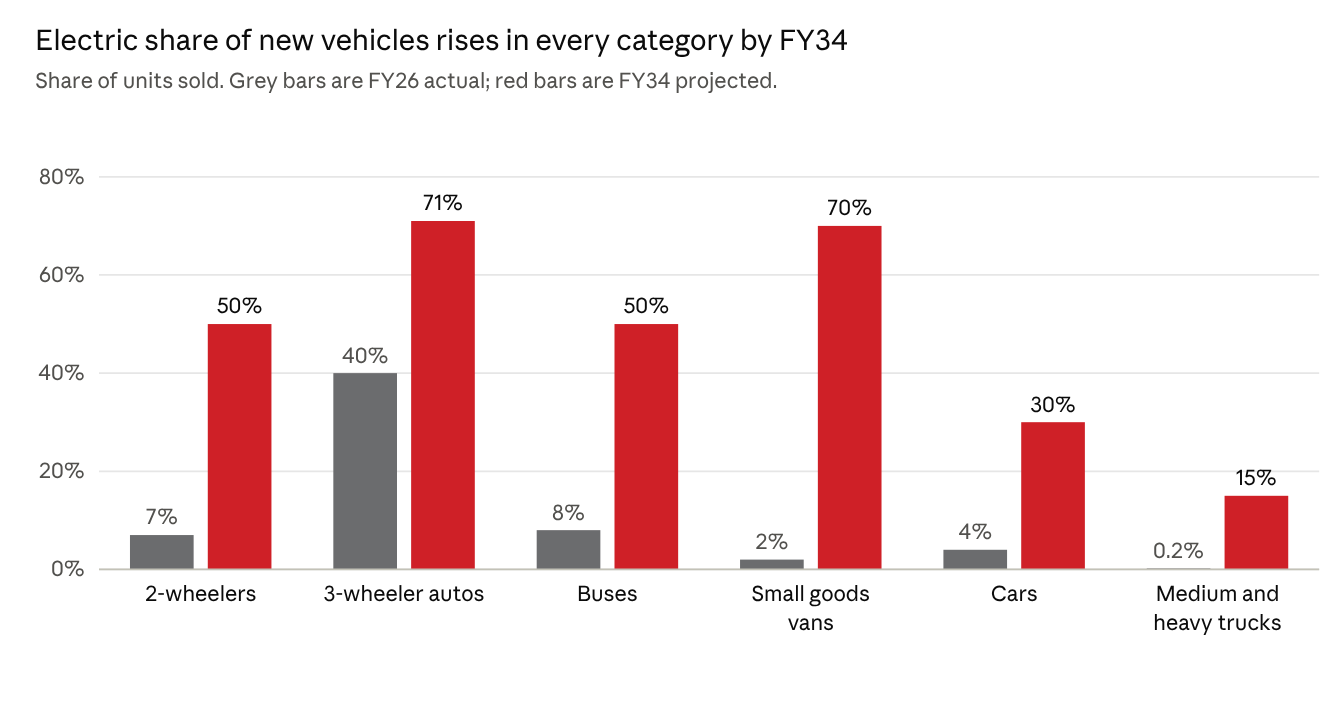
Of course the majority of volumes will come from two-wheelers, three-wheelers and cars - the same categories where leading electric players have already emerged. However, when we look at the least penetrated EV categories above, we notice small LCVs at 2% and MHCVs at under 1%. The very same categories where we find vehicles with significant ancillary functions beyond just transportation. Interestingly, these sub-categories have even lower penetration at sub 1%, because legacy OEMs are trying to retrofit their existing EV assets to these use cases, where the real economic value lies in the ancillary function and not in the transportation function for which it was designed.
Why the large manufacturers will build a variant, not the vehicle
The legacy OEMs are not absent from these vehicle categories, they sell fully built ambulances and reefer vans from the factory or through authorised body partners. But what they build is a variant. They take the platform that sells in lakhs of units, fit a body for the job and call it an ambulance or a reefer. The vehicle underneath was designed for another use case and the ancillary job is fitted into whatever is available. On diesel that works well enough, because the engine has power to spare and the fridge or the compactor easily operates off it. On an electric variant this becomes way more challenging.
The electric reefers on sale in India at the moment run the fridge off a battery pack that was sized for a last mile logistics operation and running a compressor for a 10 hour shift can significantly impact a 32 kWh pack, so the use case gets impacted. The refrigeration units themselves, diesel or electric, are bolt-ons from the likes of Carrier or Thermoking that take power from whatever the vehicle has. Nobody has yet tried a deeper integration with a single thermal system for the vehicle and battery pack, which would allow for fewer components, better efficiency and smarter controls.
We believe large OEMs will not go further and the reason is basic math rather than not being aware of the opportunity. A purpose built vehicle means a new pack, a new thermal system, new controls and a fresh homologation. For a category doing 8,000 to 12,000 vehicles a year in a country that buys 650,000 LCVs a year - the extra effort is not worth their engineering budget, energy and time.
A category that is small for them is large for a startup and each use case electric vehicle provides a multi Rs1000cr market.
Interesting use cases that exist

As highlighted above, we have a few interesting use cases where electric may make sense starting with refrigerated vans. Electric makes sense here because the fridge and not the driving is the main job. On a diesel vehicle it runs off the engine for 12 to 14 hours a day, including the wait outside the dark store, and burns diesel while it waits. On a 7 to 9 tonne truck, the amount of diesel burnt for this is almost equal to the diesel needed to move the vehicle around.
An ambulance is a vehicle that waits, both outside a hospital or at an accident site where the engine idles for hours to keep the air-conditioning, the oxygen and the monitors running. Built electric from the ground up, the medical equipment can run off the pack and the vitals can reach the emergency room before the patient does. Additionally, the Government is providing subsidies for electric and hybrid ambulances under the PM E-DRIVE Scheme (Rs500cr allocation to support 3,811 units across FY27 and FY28).
Other interesting use cases include concrete mixers, where the drum has to keep turning, so a diesel engine runs it all day through a power take off and municipal waste vehicles, where the compactor hydraulics run most of the day off the same diesel engine.
Where this goes
The vehicles are already parked outside the dark store, the hospital and the batching plant with their engines running. Over the next 3-5 years somebody will build the electric versions properly, one job at a time and we would like to meet them. If you are building a vehicle for one job, or you know someone who is, reach out or write to us!